Water Treatment Plant Process Explained: Intake to Distribution

In August 2019, only about 16.7% of India's rural households had a tap connection. By March 2026, that figure had crossed 81%, with about 15.83 crore households connected under the Jal Jeevan Mission. It is one of the largest expansions of piped water supply in India's history.
But a tap is only as good as the water that flows through it. The 2024 Functionality Assessment of certified Har Ghar Jal villages found that about 98% of surveyed households had a tap connection, but only about 76%, roughly three in four, were receiving water that met the Mission's standards for quantity, quality, and regularity. That gap sits squarely on two things: how well water is treated, and how well it is protected on its way to the tap.
That is the job of a water treatment plant. This guide explains the full water treatment plant process, from the intake at the river or reservoir to the distribution pipe outside your home, with the design numbers, quality limits, and practical lessons that decide whether a plant actually delivers safe water.
Why Raw Water Can't Go Straight to the Tap
Almost every source of water in India carries something that has to come out before people can drink it. What that "something" is depends heavily on where the water comes from.
Surface water from rivers, canals, lakes, and dam reservoirs supplies most large urban schemes. It is high in turbidity, especially in the monsoon when rivers carry heavy silt, and it carries a significant load of bacteria, viruses, and protozoa from upstream settlements and farmland.
Groundwater from tube wells and borewells is usually clearer, but it often carries dissolved contaminants that you cannot see. The foreword to IS 10500:2012, the Bureau of Indian Standards drinking water specification, cites the Eleventh Five Year Plan (2007 to 2012), which put the number of quality-affected habitations in India at about 2.17 lakh. More than half were affected by excess iron, followed by fluoride, salinity, nitrate, and arsenic.
The geography of these problems is well documented:
- Arsenic occurs in groundwater across parts of West Bengal, Bihar, Uttar Pradesh, and Assam in the Ganga and Brahmaputra basins.
- Fluoride is a major issue in Rajasthan, Gujarat, Telangana, and Andhra Pradesh.
- Nitrate from agricultural runoff appears in parts of Punjab and Haryana.
- High TDS and hardness affect large stretches of arid and coastal India.
This is why there is no single "standard" water treatment plant. The treatment train always starts from the raw water, and the raw water changes by region and by season.
Also Read: What Is Integrated Water Management and Why Does It Matter?
The Benchmark: What "Treated" Actually Means in India
A water treatment plant is designed to bring water within the limits of IS 10500:2012. The standard defines two limits for each parameter. The acceptable limit is the target for safe supply. The permissible limit applies only when no alternate source is available, and if water exceeds even that, the source has to be rejected.
Here are the parameters that shape most treatment plant design decisions:
Filter type | Typical filtration rate | How it works | Best fit |
Rapid gravity sand filter | About 5 to 7 m/hr | Water flows down through graded sand and gravel under gravity | The standard choice for municipal surface water plants in India |
Dual media filter | Higher than single media | Coarse anthracite over fine sand traps particles through the depth | Higher loads and longer filter runs |
Pressure filter | Varies by design | Media sealed inside a pressurised steel vessel | Small towns, industrial supply, groundwater schemes |
Slow sand filter | About 0.1 to 0.2 m/hr | A biological layer on the sand surface treats water slowly | Small rural schemes with low, stable turbidity |
Ultrafiltration (membrane) | Varies by system | A physical membrane barrier removes particles and most pathogens | Compact plants and sites needing very consistent quality |
The Water Treatment Plant Process, Step by Step
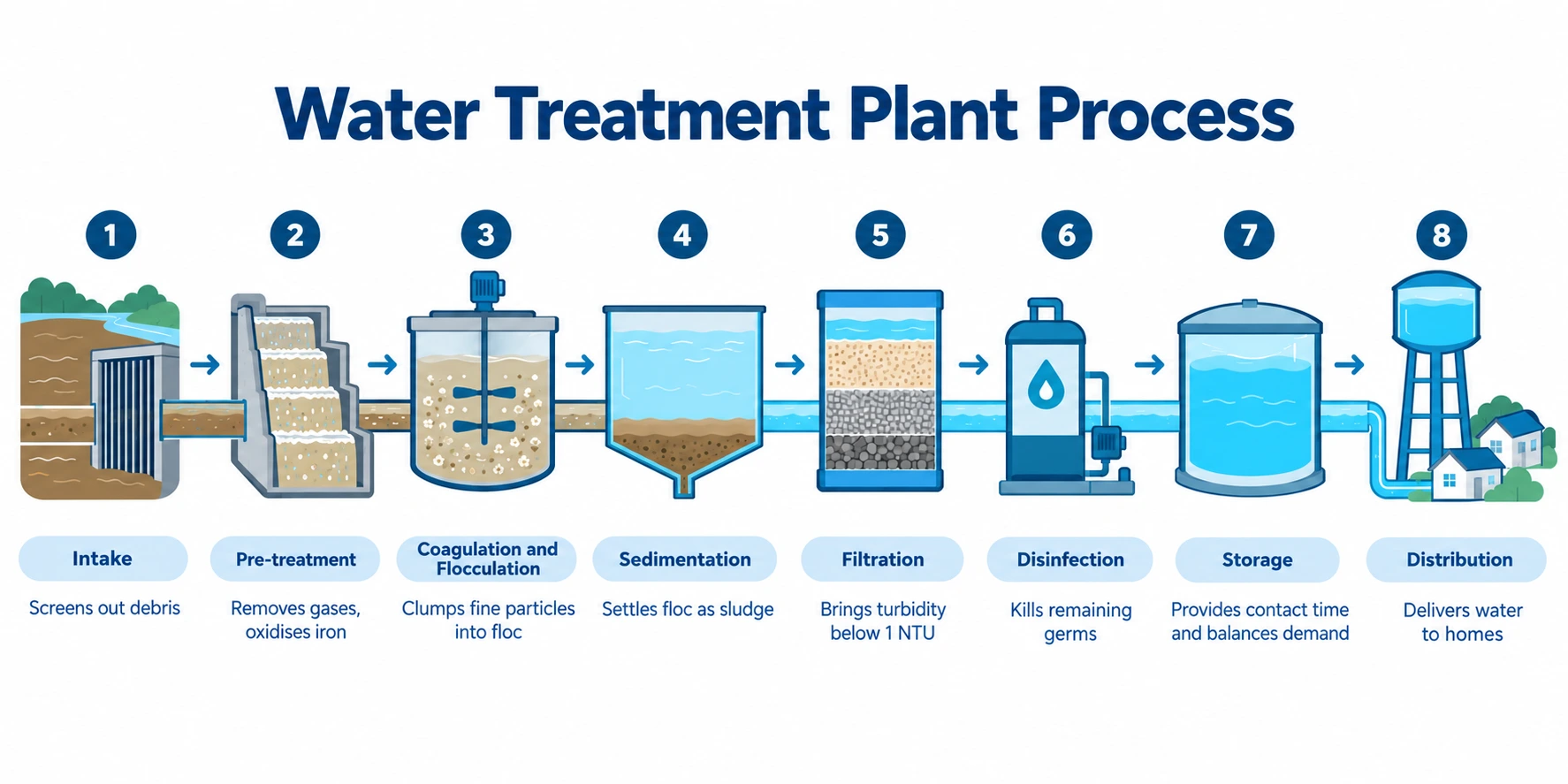 A conventional surface water treatment plant follows eight stages. The typical design values below follow commonly used CPHEEO (Central Public Health and Environmental Engineering Organisation) guidance, though every plant is finally designed around its own raw water data and site conditions.
Stage 1: Intake and Screening
Everything begins at the intake, the structure that draws raw water from the source. Depending on the source, this can be a river intake well, a jack well, a reservoir intake tower, or a submerged intake pipe.
- Coarse bar screens at the intake stop branches, plastic, vegetation, and floating debris.
- Fine screens catch smaller material before it reaches the raw water pumps.
- Raw water pumping stations then lift the water into a transmission main that carries it to the treatment plant, which may be several kilometres away.
Intake location is one of the hardest decisions to reverse. A good intake sits where water depth is reliable even in the driest summer, where silt and bank erosion are limited, and where it can draw water from more than one level if quality varies with depth. Silting, shifting river channels, and falling summer water levels are among the most common reasons intakes underperform. Seasonal source data, collected over several years, is the foundation for getting this right.
Also Read: Water Level Monitoring Systems: A Complete Guide
Stage 2: Pre-Treatment (Aeration and Pre-Chlorination)
When raw water enters the plant, it passes through an inlet chamber where flow is measured, often with a Parshall flume. Depending on water quality, it then goes through one or both pre-treatment steps.
Aeration exposes water to air through cascade aerators, tray aerators, or spray nozzles. It removes dissolved gases like hydrogen sulphide that cause odour, releases excess carbon dioxide, and oxidises dissolved iron and manganese into solid particles that later stages can remove. It is especially valuable for groundwater sources.
Pre-chlorination or pre-oxidation is used where raw water carries algae, high organic load, or heavy bacterial contamination. It also prevents biological growth inside tanks and filters.
Neither step is automatic. Both should be decided on the basis of raw water testing, because unnecessary pre-chlorination of water rich in organic matter can increase the formation of disinfection by-products such as trihalomethanes, which IS 10500 now also regulates.
Stage 3: Coagulation and Flocculation
The particles that make water cloudy, such as clay, silt, and organic colloids, are tiny and carry a negative electrical charge. They repel each other and can stay suspended almost indefinitely. Coagulation and flocculation make them removable.
Coagulation takes place in a flash mixer, where a coagulant is added and mixed violently for a very short time, typically 30 to 60 seconds. The coagulant neutralises the charge on the particles so they stop repelling each other.
- Alum (aluminium sulphate) is the most common coagulant in India. Typical doses range from about 10 to 80 mg/L depending on season, with turbid monsoon water needing the highest doses.
- Poly aluminium chloride (PAC) is increasingly used because it often works at a lower dose than alum and produces less sludge, though the saving varies with raw water quality.
- Ferric salts are used in some plants, particularly where colour removal is a priority.
Flocculation follows in a flocculator, where slow paddles or baffled channels gently stir the water for about 10 to 40 minutes, with around 30 minutes a common design value. The destabilised particles collide, stick together, and grow into visible clumps called flocs.
Dosing is where good plants and struggling plants separate. Too little coagulant leaves turbidity behind. Too much wastes chemicals, increases sludge, and can leave residual aluminium in treated water. Operators set doses using jar tests, which simulate treatment on small samples of raw water, and the best-run plants repeat them every time raw water quality shifts, sometimes several times a day during the monsoon.
Stage 4: Sedimentation and Clarification
Flocculated water then flows slowly through a sedimentation tank or clarifier. With the flow calmed, heavy flocs settle to the bottom as sludge, and clarified water flows over weirs at the top.
Common designs used in Indian plants include:
- Rectangular horizontal-flow sedimentation tanks, simple and robust for large plants.
- Circular clarifiers with mechanical sludge scrapers.
- Clariflocculators, which combine flocculation in an inner zone and clarification in an outer zone within a single circular unit. They are widely used in municipal schemes because they save space.
- Tube or plate settlers, which add inclined surfaces inside the tank to multiply the effective settling area. They are a common way to increase the capacity of an existing plant without building new tanks.
For a sedimentation tank, the surface loading rate (flow divided by surface area) matters more than depth. For settling tanks and clariflocculators treating coagulated water, a common design range is about 30 to 40 m³/m²/day, roughly 1.25 to 1.7 metres per hour, with a detention time of around two hours. Tube and plate settlers allow higher loading rates. A well-performing clarification stage removes the bulk of turbidity before the water reaches the filters, which protects them from clogging and lengthens filter runs.
Sludge handling. The settled sludge is withdrawn regularly from the tank floor, either by scrapers or through desludging valves. It is then thickened and dewatered using drying beds, centrifuges, or filter presses, and the water separated from it is usually returned to the head of the plant. Planning this from the start avoids one of the most common operating problems at Indian plants: sludge discharged untreated into drains or rivers.
Stage 5: Filtration
Settled water still carries fine particles, residual floc, and some microorganisms. Filtration removes them by passing water through beds of granular media.
Filter type | Typical filtration rate | How it works | Best fit |
Rapid gravity sand filter | About 5 to 7 m/hr | Water flows down through graded sand and gravel under gravity | The standard choice for municipal surface water plants in India |
Dual media filter | Higher than single media | Coarse anthracite over fine sand traps particles through the depth | Higher loads and longer filter runs |
Pressure filter | Varies by design | Media sealed inside a pressurised steel vessel | Small towns, industrial supply, groundwater schemes |
Slow sand filter | About 0.1 to 0.2 m/hr | A biological layer on the sand surface treats water slowly | Small rural schemes with low, stable turbidity |
Ultrafiltration (membrane) | Varies by system | A physical membrane barrier removes particles and most pathogens | Compact plants and sites needing very consistent quality |
In a rapid sand filter, sand typically has an effective size of 0.45 to 0.70 mm and sits on a supporting layer of graded gravel. A properly operated rapid sand filter brings turbidity below 1 NTU.
Over time, filters clog. They are cleaned by backwashing, where water, often combined with air scouring, is pushed upward through the bed to lift and wash out trapped particles. Rapid sand filters are commonly backwashed every 24 to 48 hours, depending on load. The used backwash water is usually recovered and recycled to the head of the plant rather than wasted.
Stage 6: Disinfection
Filtration removes most pathogens, but not all. Disinfection is the final barrier before water leaves the plant.
- Chlorination remains the backbone of disinfection in India, using chlorine gas, sodium hypochlorite, or bleaching powder. The dose is set by testing the water's chlorine demand, and a minimum contact time of about 30 minutes is provided before water is supplied. Its biggest advantage is the residual it leaves behind, which keeps protecting water as it moves through the network.
- UV disinfection inactivates microorganisms without chemicals, but it leaves no residual, so it is usually paired with a small chlorine dose for distribution.
- Ozonation is a strong oxidant that also improves taste, odour, and colour. It is more expensive to operate and also needs a secondary disinfectant for the network. Read more in our guide to ozone water treatment.
The balancing act is precise. The plant must dose enough chlorine to satisfy the water's chlorine demand, complete disinfection within the contact time, and still leave at least 0.2 mg/L free residual chlorine at the farthest tap, without overdosing to the point where consumers complain about taste and smell.
Stage 7: Storage in Clear Water Reservoirs
Treated water flows into a clear water reservoir (CWR) or clear water sump at the plant. Storage does two jobs. It provides the contact time that disinfection needs, and it balances the plant's steady output against demand that spikes in the morning and evening.
From the CWR, clear water pumps send treated water through transmission mains to elevated service reservoirs (ESRs), overhead tanks, and ground-level service reservoirs located across the supply zone. These reservoirs maintain pressure in the network and provide a buffer during power failures or maintenance shutdowns.
Stage 8: Distribution
Distribution is the final stage of the journey from source to tap, and it is where many systems lose what the plant has achieved.
The network carries water from service reservoirs to consumers through a hierarchy of trunk mains, distribution mains, and service connections, moving by gravity where terrain allows or with booster pumping stations where it doesn't. SPML Infra's pipeline network solutions cover this transmission and distribution layer, from hydraulic design to commissioning.
Three factors decide distribution performance:
- Pressure. Adequate, stable pressure keeps supply reliable and prevents contaminated groundwater from being drawn into pipes through cracks and joints.
- Leakage and non-revenue water (NRW). An ORF analysis estimates that Indian urban utilities lose about 38% of their potable water to NRW on average, roughly double the 15 to 20% benchmark considered acceptable. Every litre lost has already been pumped, dosed, and treated. Our guide to water leak detection and NRW reduction explains how utilities find and fix these losses.
- Supply continuity. Intermittent supply, where pipes empty and refill daily, is one of the biggest risks to water quality in India. When pipes depressurise, contamination enters.
This is why the shift towards continuous pressurised supply, District Metered Areas, smart water metering, and real-time network monitoring matters as much as the treatment plant itself. Read more about how SPML approaches this in its 24x7 urban water supply work.+
Also Read: What Is AMRUT 2.0 and What It Means for India's Water Infrastructure
How the Process Changes for Groundwater Sources
The eight stages above describe a plant treating river or reservoir water, where turbidity and microbes are the main targets. Groundwater schemes usually need less clarification but more targeted removal of dissolved contaminants, so the treatment train is built around what the source actually contains.
- Iron and manganese. These are the most widespread groundwater problems. Aeration oxidises the dissolved metals into particles, which are then removed in gravity or pressure filters, often packaged as iron removal plants. The IS 10500 limit for iron is 0.3 mg/L.
- Arsenic. Removal units typically use adsorption media such as activated alumina or iron-based adsorbents, or coagulation followed by filtration. The spent media and sludge contain concentrated arsenic and need safe disposal.
- Fluoride. Common options include activated alumina adsorption, the Nalgonda technique (alum and lime dosing followed by settling), and reverse osmosis for smaller supplies.
- High TDS and salinity. Reverse osmosis is the usual answer, though it produces a reject stream that needs managing. Blending with a lower-TDS source is sometimes used where available.
- Nitrate. Ion exchange or reverse osmosis can remove it, but blending or switching sources is often more practical at scale.
Whatever the contaminant, groundwater still needs disinfection before supply. For habitations badly affected by arsenic and fluoride, government guidelines have long favoured surface water based piped water supply schemes as the permanent solution, which is why many large rural schemes now draw water from rivers and reservoirs and treat it at a central plant before piping it across dozens of villages.
What a Well-Designed Water Treatment Plant Delivers
When the full process is designed and operated as one system, the gains go well beyond meeting a test report.
- Consistent quality across seasons. Plants that are designed for monsoon turbidity, not average turbidity, keep output steady when demand and raw water challenges both peak.
- Lower chemical and energy costs. Correct dosing, efficient filters, and well-sized pumps reduce operating expense over decades of operation.
- Less waste. Backwash recovery and planned sludge dewatering save raw water and avoid environmental complaints.
- Faster response to change. SCADA and PLC automation let operators adjust dosing, filter cycles, and pumping in real time instead of reacting after a quality failure.
- Safer water at the tap, not just at the plant. Integrated planning of treatment, storage, and distribution protects water all the way to the consumer.
SPML's Water Treatment Experience
SPML Infra designs and builds treatment plants as part of complete source-to-tap systems. Current work includes a 400 MLD water treatment plant with a 1,650 MLD intake for Indore under AMRUT 2.0, along with clear water pumping and transmission mains and a 10-year O&M contract, and a 160 MLD water treatment plant in Kekri, Rajasthan under the Jal Jeevan Mission, with clear water reservoirs, nearly 59 km of pipelines, and SCADA-based monitoring. Earlier, SPML's Pokhran water supply project in Rajasthan included three water treatment plants with a combined capacity of 125.3 MLD.
Conclusion
The water treatment plant process is a chain, and each link protects the next. Screening protects pumps. Coagulation makes invisible particles removable. Sedimentation and filtration bring turbidity below 1 NTU. Disinfection handles the pathogens that remain. Storage and distribution then decide whether that safe water actually reaches the people it was treated for.
India has built tap connections at remarkable speed. The next challenge is making sure every one of those taps delivers water that is safe, adequate, and reliable, and that depends on treatment plants and networks designed, built, and operated as one integrated system.
SPML Infra delivers end-to-end EPC solutions across the entire water cycle, from source development and transmission to treatment, storage, distribution, and lifecycle maintenance. Our teams have built water infrastructure for municipalities, utilities, and industries across India, backed by smart water management capabilities, including more than 5 lakh smart water meters deployed across urban networks and SCADA-based automation of treatment plants and pumping stations.
To discuss your project, explore SPML's water infrastructure solutions or request a project consultation.
FAQs
What are the main stages of water treatment?
Intake and screening, pre-treatment, coagulation and flocculation, sedimentation, filtration, disinfection, storage, and distribution.
What is the water treatment plant process in simple words?
Raw water is screened, dirt particles are clumped together and settled, the water is filtered through sand, and chlorine is added before it is piped to homes.
Which chemical is used for coagulation in India?
Alum is the most common coagulant. Poly aluminium chloride (PAC) is increasingly used because it often works at a lower dose and produces less sludge.
What is the acceptable turbidity of drinking water in India?
IS 10500:2012 sets the acceptable limit at 1 NTU, with 5 NTU permissible only when no alternate source exists.
Why is chlorine needed after filtration?
It kills the germs that filtration misses and leaves a residual of at least 0.2 mg/L that keeps protecting water through the pipe network.
How long does the water treatment process take?
Usually a few hours from inlet to clear water reservoir. Flocculation takes about 30 minutes, settling around two hours, and chlorine contact at least 30 minutes, with the total depending on plant design and flow.
How is water treatment plant capacity measured?
In India, capacity is usually stated in MLD (million litres per day), the volume of treated water a plant can produce in 24 hours.
How is groundwater treated for arsenic or fluoride?
Arsenic is usually removed with adsorption media or coagulation and filtration. Fluoride is removed with activated alumina, the Nalgonda technique, or reverse osmosis.
How is a water treatment plant different from a sewage treatment plant?
A water treatment plant makes raw water safe to drink, while a sewage treatment plant treats used wastewater for discharge or reuse.
Is treated water safe to drink straight from the tap?
It leaves the plant safe, but leaks, low pressure, or dirty storage tanks can contaminate it before it reaches the tap.