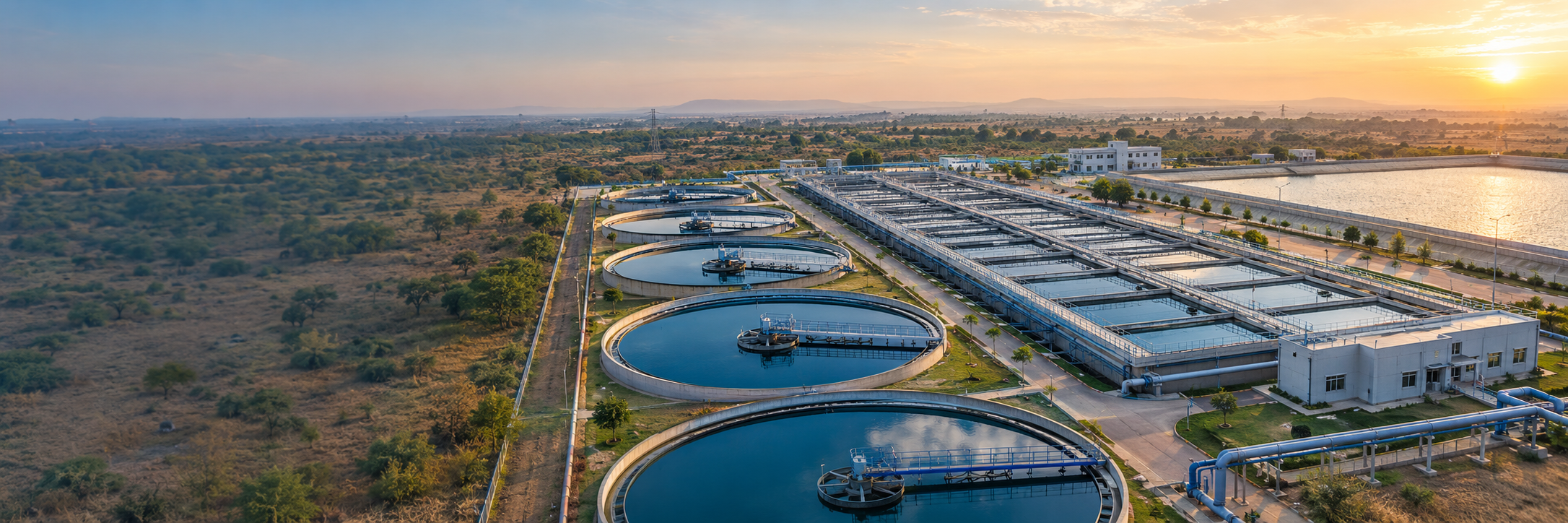
Raw water drawn from rivers, lakes, canals and groundwater carries sediment, microorganisms and dissolved contaminants. A water treatment plant (WTP) removes these before the water enters a city's supply network. SPML Infra designs, builds, operates and maintains large-capacity WTPs for municipal and bulk water supply schemes across India. Its plants in Jaipur, Pokhran and Sawai Madhopur together treat 471 MLD, serving millions of people.
How a Water Treatment Plant Works
Most surface water plants follow the same core sequence. The processes chosen at each stage depend on raw water quality.
- Intake and pre-treatment: raw water is screened, and chemicals or ozone are added to prepare it for treatment.
- Coagulation and flocculation: coagulants bind fine particles into larger flocs.
- Clarification: the flocs settle out in clarifiers, leaving clearer water above.
- Filtration: media filters remove the remaining suspended particles.
- Advanced treatment (where needed): membranes, activated carbon or targeted removal processes deal with specific contaminants.
- Disinfection: pathogens are neutralised before the water is stored.
- Storage and pumping: treated water moves to clear water reservoirs and on to transmission.
- Residuals handling: filter backwash water is recovered and sludge is managed.
What SPML Delivers
- Design and engineering: raw water analysis, process selection, hydraulic design and plant layout.
- Procurement: treatment equipment, chemical systems, pumps and electro-mechanical works.
- Construction: civil works for intake structures, treatment units and reservoirs.
- Testing and commissioning: trial runs to confirm output quality and capacity before handover.
- Operation and maintenance: long-term O&M contracts. The Pokhran scheme, for example, carries 10 years of O&M.
Treatment Technologies
Pre-treatment
- Pre-ozonation. See our guide on ozone water treatment.
- Chemical dosing
Coagulation and clarification
- Flocculators
- Lamella settlers
- Sludge blanket and pulsator clarifiers
Filtration and adsorption
- Single-media and multi-media filtration
- Activated carbon adsorption
Advanced treatment
- Membrane filtration, including ultrafiltration (UF) and reverse osmosis (RO)
- Electrodialysis reversal (EDR)
- Advanced oxidation process (AOP)
Targeted contaminant removal
- Iron removal
- Arsenic removal
Residuals management
- Backwash water recovery systems
SPML also designs treatment systems for industrial clients that need to process water to a specific quality.
These plants treat raw water to drinking standards. Wastewater treatment and reuse, including tertiary treatment with UF and RO, is covered under SPML's sewage and tertiary treatment solutions.
Standards
In India, treated drinking water is measured against IS 10500, the Bureau of Indian Standards specification for drinking water. The planning and design of water treatment plants is guided by the Manual on Water Supply and Treatment, published by the Central Public Health and Environmental Engineering Organisation (CPHEEO) under the Ministry of Housing and Urban Affairs.
Execution Models
- EPC: SPML designs and builds the plant, and the client authority operates it.
- EPC with O&M: SPML builds the plant and runs it for a fixed contract period, which on SPML's major schemes has been up to 10 years.
- PPP and BOOT: SPML has worked under Public Private Partnership and Build-Own-Operate-Transfer structures in the water sector.
Project Experience
Jaipur Water Supply Project, Rajasthan
- 200 MLD water treatment plant
- Drinking water for over 4 million people in Jaipur city
- 2 underground pumping stations and 70 km of pipeline up to 1,400 mm diameter
Chambal-Sawai Madhopur-Nadauti Water Supply Project, Rajasthan
- 146 MLD water treatment plant
- Drinking water for half a million people across 926 villages and 3 towns in Sawai Madhopur and Karauli districts
Pokhran Water Supply Project, Rajasthan
- 125 MLD water treatment plant with a 300 million litre raw water reservoir
- Drinking water for 1.2 million people across 580 villages in Jaisalmer and Barmer districts, plus supply to defence forces and industries
- 10 years of O&M
Related Solutions
Frequently Asked Questions
What is a water treatment plant?
A water treatment plant is a facility that treats raw water from rivers, lakes, canals or groundwater to make it safe to drink. It removes sediment, microorganisms and dissolved contaminants through stages such as coagulation, clarification, filtration and disinfection.
What does MLD mean for a water treatment plant?
MLD stands for million litres per day. It measures how much treated water a plant can produce in a day. SPML's Jaipur plant, for example, has a capacity of 200 MLD.
What is the difference between ultrafiltration and reverse osmosis?
Ultrafiltration uses membranes to remove suspended particles, bacteria and some viruses. Reverse osmosis uses much finer membranes that also remove dissolved salts and many chemical contaminants. RO produces higher-purity water but uses more energy.
How is a water treatment plant different from a sewage treatment plant?
A water treatment plant turns raw water into drinking water. A sewage treatment plant treats used wastewater so it can be safely discharged or reused.
Does SPML operate water treatment plants after construction?
Yes. SPML takes on long-term O&M contracts. The Pokhran Water Supply Project, for example, includes 10 years of operation and maintenance.